

Spring 2026 Winner of the Civil Rights Scholarship
Elektra Gea-Sereti
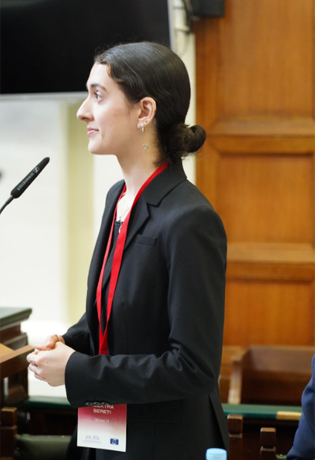
Read the winning essay:
Topic: What are the most important civil rights issues that affect millennial workers? Do millennials need to be better informed about how they can protect their rights in the workplace? How can workers make sure they understand their rights and the ways they can protect themselves?
As Gen-Z floods the workspace and feeds are dominated by posts joking about the new workplace dynamics, it is easy to forget that there is another generation that is also currently employed. In fact, a specific generation suffers constantly from race, origin, gender, sexuality, and age-based discrimination. This generation has substantially less digital privacy rights, and they also have unequal access to social protections such as labor rights and economic security. These are only three of the main civil rights issues that affect millennials. Both in Europe and in the US, origin (real or presumed) is one of the top-cited reasons for workplace discrimination, according to an INSEE 2021 Survey on Discrimination (INSEE, 2021). In the US, studies have found that racial discrimination in hiring explains 44-52% of the wage gap between white and black workers (Arora et al., 2024). For millennials, who are the most racially and ethnically diverse adult generation currently, more individuals are directly exposed to race-based discrimination throughout their careers. According to the Center for American Progress, LGBTQ+ millennial workers experience disproportionately higher rates of harassment and discrimination, especially transgender workers (Glynn & Walters, 2021), and in technology industries, 2025 research has found that women and non-binary workers report higher discrimination and greater mental-health harm (Dev et al., 2025). It may seem entertaining to watch social media poke fun at Gen-Z’s work culture, but age-based discrimination against younger workers and bias against millennials is still significant. Young adults face age discrimination, from being overlooked to not being taken seriously, according to 2025 research (Ageism in Academic and Professional Settings, 2025). Millennial workers have reported that generational stereotypes have negatively shaped hiring evaluations and workplace culture, and this form of “reverse ageism” is often not recognized by law (Inns of Court, 2023). Most age discrimination laws protect older workers (Younger Worker Discrimination, 2017), but not younger ones who have to combat harmful stereotypes and discrimination that can limit the advancement of their careers.
Beyond discrimination, millennials face more employer surveillance than previous generations, impacting autonomy, dignity, and freedom of expression. Constant monitoring of technology usage, tracking personal social media, algorithmic systems evaluating performances, or guiding promotions, all erode privacy and can subject workers to further biases (especially from algorithms). Millennial workers are also overrepresented in stores where this surveillance is highest (such as customer service, retail, tech, and remote work). Most of these data come from the European Commission, the OECD, and the EU Agency for Fundamental Rights; however, it is still applicable to the US. Algorithms and digital surveillance constitute gross privacy violations; however, legislation has not yet caught up to how to address these challenges. Using AI and algorithms to screen resumes, CVs, and decide promotions all leave individuals at risk of suffering severe forms of discrimination, as AI models tend to use biased data or make incomplete reviews. The EU has developed stronger rights protections against AI and surveillance (such as the GDPR and the EU Artificial Intelligence Act); however, the US has not followed suit to protect millennial workers. Lastly, to tie it all together, millennials face unequal access to social protections such as labor rights and economic security. They have jobs with fewer legal protections, with rising short-term contracts, unpaid internships, part-time involuntary work, limited access to union protection, and barriers
to standing up for themselves due to fears of losing their employment. Workers who do not have stable contracts are less likely to exercise their rights for fear of retribution; these instabilities disproportionately affect racial minorities, and in the end, limit social mobility because they curtail wealth building, housing access, and general job and financial stability. The ILO has shown that millennials face higher rates of non-standard work agreements than Gen X or Boomers at the same age. The OECD shows younger workers in precarious and unprotected jobs and the EU has found that the rise of platform work is eroding worker protections and rights. In the current US climate, millennials are working multiple jobs simply to pay the bills. It is easier for employers to get away with rights violations because, to an extent, workers’ hands are tied. If losing a paycheck means losing the ability to put food on the table, nobody is willing to take the risk.
Millennials do need to be better informed and protect their rights in the workplace, but this is a two-way street. For one, legislation needs to catch up to account for rising AI and technology in hiring and screening practices. Following the EU’s steps, legislation should be created to more strongly protect workers’ rights in the face of technology, which has been proven to have biases and faults in algorithmic decision-making. Secondly, legislation that protects older generations from ageism needs to be adopted for younger generations. Data show that younger generations also face ageism and discriminatory practices; if frameworks for legislation already exist, it is simpler to then adjust them for both ends of the age spectrum. Millennials themselves can become more informed about their rights and their protections by joining unions. In large businesses, having signs disclosing workers’ rights, union availability, and free legal consultations can all help diminish the anxiety millennials may feel when it comes to raising rights concerns. Unfair workplace practices must be reported through clear channels, with an emphasis on anonymity so workers feel protected. Workers should both do individual research to know their rights, but should also be supported by the employers, with transparency in practices and the ways of reporting any issues. Advertising free legal consultations, willing to review contracts or hear complaints, can also provide an extra resource to millennials. There is a dual effort that needs to occur to ensure millennial workers’ rights; millennials themselves have a responsibility to be informed and proactive, but society also has a responsibility to ensure legislation is relevant, and that employers are accountable in ensuring their workers have access to resources and support.
Word Count: 985
Works Cited (APA 7th Edition)
1. Ageism in academic and professional settings. (2025). Springer Nature. https://doi.org/xxxxx
2. Arora, R., Choi, S., Madsen, J., & Wang, P. (2024). Estimation of labor market frictions and racial discrimination (arXiv:2412.00615). arXiv. https://arxiv.org/abs/2412.00615
3. David Publishing. (2017). Younger worker discrimination. David Publishing.
4. https://doi.org/xxxxx
5. Dev, S., Li, Q., & Narayanan, A. (2025). Workplace discrimination in software development (arXiv:2510.22457). arXiv. https://arxiv.org/abs/2510.22457
6. Eurofound. (2021–2023). Platform work and evolving labour protections: Annual labour market reports. European Foundation for the Improvement of Living and Working Conditions. https://www.eurofound.europa.eu
7. European Commission. (2021). The digitalisation of the workplace: Challenges and opportunities for workers’ rights. Publications Office of the European Union. https://ec.europa.eu/social/
8. European Union Agency for Fundamental Rights. (2021–2023). Fundamental rights in the digital age: Annual reports. FRA. https://fra.europa.eu/en/publications
9. Glynn, S. J., & Walters, S. (2021). Promoting good jobs for millennials. Center for American Progress. https://www.americanprogress.org/article/promoting-good-jobs-for-millennials/
10. INSEE. (2021). Les discriminations dans l’emploi. Institut national de la statistique et des études économiques. https://www.insee.fr/fr/statistiques/7760309
11. Inns of Court. (2023). Millennial stereotypes and professional barriers. American Inns of Court Foundation. https://inns.innsofcourt.org/media/197421/millennial-ppt-january-2023-final.pdf
12. International Labour Organization. (2022). Non-standard forms of employment and young workers. ILO. https://www.ilo.org
13. OECD. (2023). Algorithmic management and the implications for labour rights. OECD Publishing. https://www.oecd.org/employment/
14. OECD. (2023). Precarious and non-standard work among young adults: Labour market risks and policy responses. OECD Publishing. https://www.oecd.org/employment/