

Fall 2025 Winner of the Civil Rights Scholarship
Mina Anochie
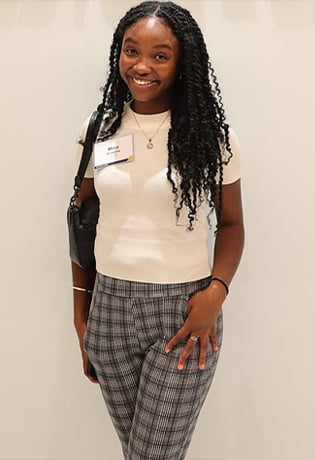
Read Mina’s Essay:
As I threw the final rose over my mother’s casket, I could not help but think about the ongoing fear of deportation that had once consumed her life due to immigration laws and policies. In 2017, my mother began experiencing migraines, coughs, and dizziness. Out of fear for her legal status, she refused to seek medical attention. Even if she had overcome her discomfort, her status as an immigrant created systemic barriers. My mother could not find a job with health benefits and as a result remained unprotected from discrimination in healthcare.
Losing my mom at such a young age was devastating. In an ideal world, no one would have to bury their parent under such circumstances. But immigration and civil rights laws often deny people like my mother their humanity, forcing them to live in the shadows and suffer in silence. Her death became a painful reminder of how the lack of legal access and civil rights awareness continues to harm historically marginalized communities—especially in the workplace. Many millennial workers today still face challenges rooted in the same inequities: lack of access to benefits, fear of retaliation, and discrimination based on race, age or gender.
Standing over her casket, I was overwhelmed by grief and fear. What would I do without her? I did not have immediate answers, but I knew one thing: this could not happen to anyone else. If my mother had access to legal support—someone to help her understand her civil rights and how to protect herself in the workplace she might still be alive. This tragedy forced me to ask: How can workers make sure they understand their rights and the ways they can protect themselves before it’s too late? As a future civil rights attorney, my mission is to ensure no one has to ask that question alone.
That commitment began with my decision to join the City of Los Angeles Civil + Human Rights and Equity Department (LA Civil Rights) in 2022. At LA Civil Rights, I contribute to projects that use the law as a tool for justice, including investigating hate incidents reported by constituents. Even in 2025, I continue to witness discrimination rooted in race, gender, culture, age, religion, and immigration status. These experiences reinforce what I’ve learned: that legal rights mean little without the ability to adequately exercise them, and that too many workers—particularly millennial workers—remain unaware of the protections they are entitled to under the law.
My work has also shown me that legal empowerment and resources must be accessible. I want to be someone who demystifies the legal system and creates safe, inclusive spaces for workers to ask questions, share their stories, and access justice. Many workers, especially millennials, are unaware of their rights related to safety, wage equity, and discrimination protections. Some don’t even realize they are being mistreated until it’s too late. Others fear retaliation if they speak out. Therefore, workers can protect themselves by accessing trusted resources such as government labor websites, legal aid clinics, workers’ rights organizations, and community groups like LA Civil Rights. Knowing your rights around safety, discrimination, and labor protections is the first step—because, indeed, knowledge is power. But knowledge alone is not enough. Empowerment requires systems and coalitions of people that enforce those rights and advocates who amplify the needs of the unheard.
The law, when used with compassion and purpose, can be transformative. With this scholarship, I will continue pursuing my education and advocacy, grounded in the strength I’ve gained through personal loss and public service. My experiences have reinforced my belief in the importance of justice, access and equity. As a future attorney, I will fight to expand access, amplify marginalized voices, and ensure dignity and justice are not privileges for some, but rights for all—especially for the communities I come from.